


In 2018 Outset Germany_Switzerland supported artists Grada Kilomba's and Heba Y. Amin's works at the 10th Berlin Biennale.
Grada Kilomba "Illusions Vol. II":
In her series "Illusions" (2016-present) Grada Kilomba is combining greek mythology with video, text and storytelling in order to research how symbolism and allegory contain a potential for suppression. In her live performances, she recounts a story in each case, turns her metaphors gradually into their opposite, and undertakes a profound analysis of the repressive, racist connotations and gender-specific social conditions inherent in the historical structure. Kilomba questions our approach to oppression and at the same time wants to expose the dynamics of exploitation, to concentrate power and supposedly marginalize the periphery - an unnatural and disruptive process for the whole of society.
By appropriating the stories and languages that transport this dynamic, Grada Kilomba initiates conversations that seek to deconstruct our notion of otherness. For the 10th Berlin Biennale, the artist continued to develop her series "Illusions", which began in 2016 with the story of Narcissus and Echo. Now she introduced the myth of Oedipus and analysed those fatal tensions between father and son, which result in a tragedy. In film and music, combined with verbal narrative traditions, Kilomba explored the role that fate can play for those living in a system of reproducing cyclical oppression based on the themes of loyalty and violence.
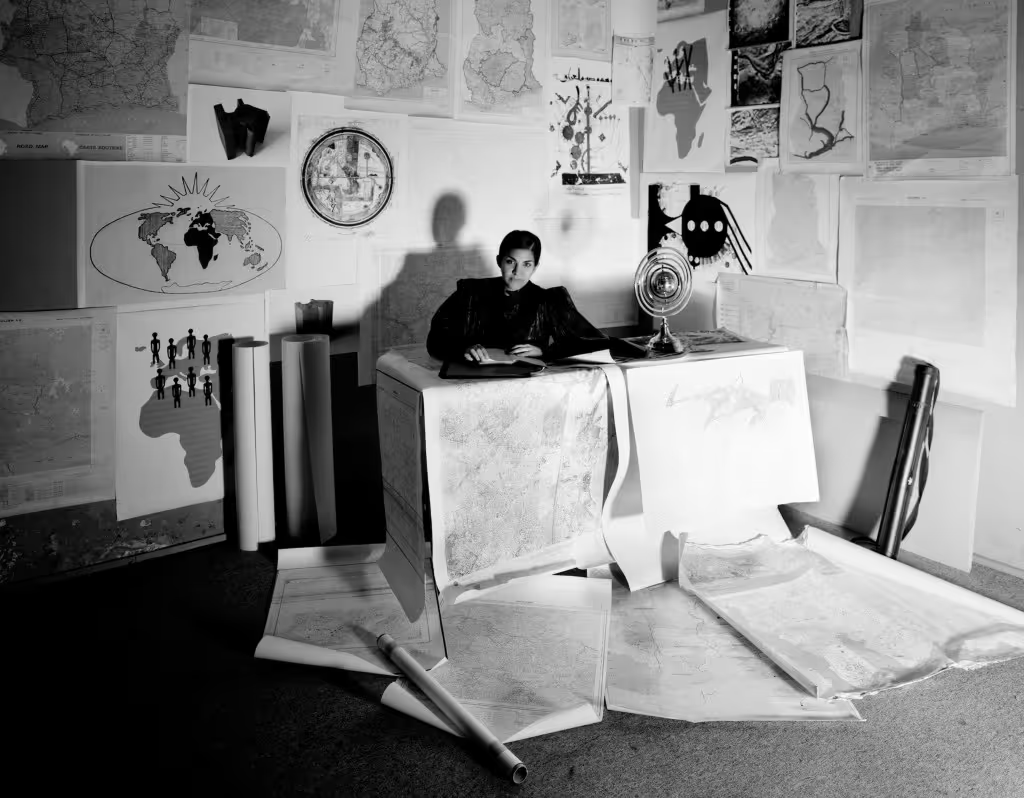
Heba Y. Amin "Anti-Control Room":
Heba Y. Amin was born 1980 in Cairo, Egypt. She lives and works in Berlin. Amin is a visual artist, lecturer at Bard College Berlin and doctoral fellow of the Graduate School for Muslim Cultures and Societies at the Freie Universität Berlin. In her research-based artistic practice, Amin explores the historical paradigms of technology and urban development in relation to today's migration pathways. Her projects question the emergence and construction of political contexts, including their distortions and memory gaps. Amin uses a variety of media to investigate the impact of imposed infrastructure on the human psyche.
'Heba Y. Amin appropriates the megalomaniac idea of a supercontinent in her Anti-Control Room, part of her larger project, Operation Sunken Sea. Having presented the project in the spring of 2018 at the Mediterranean Institute of the University of Malta, Amin shows further materials in Berlin, as well as documentation of other utopian visions for alternative geographies. The project Operation Sunken Sea (The Anti-Control Room) (2018) blurs the lines between history, the present, and the future; between truth, fiction, and megalomania. Amin leaves us with an uneasy feeling of insecurity about the kind of a world we are currently inhabiting—and the world we might wish (or not wish) to inhabit.' —Yvette Mutumba

