

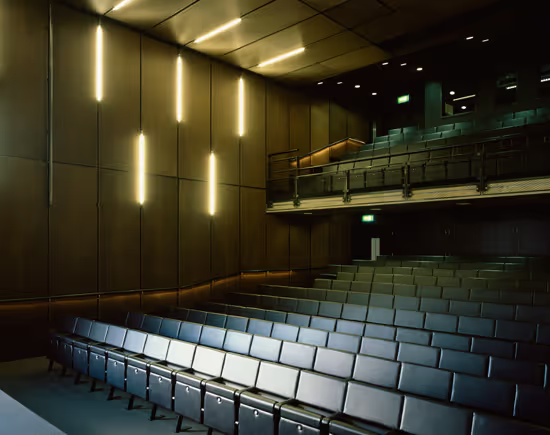
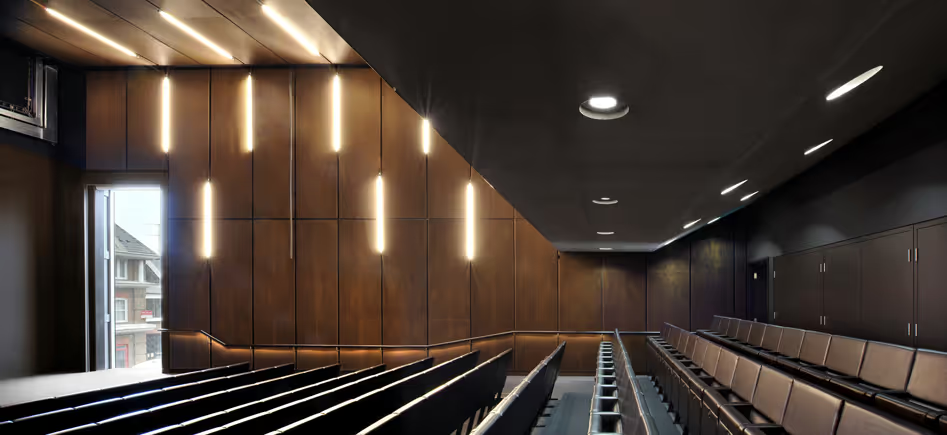
After three consecutive years of the Outset / RCA Acquisitions Fund, Outset was delighted to engage in a new project with the Royal College of Art, the RCA / Outset Visual Cultures Lecture Series.
Founded in 1837, the RCA is the world’s oldest art & design university in continuous operation and is unique in being the world’s only wholly postgraduate art & design university. It has 900 students studying at Master’s level and 100 M.Phil and Ph.D students.
With the advent of a 225 seat lecture theatre in the Dyson Building in 2012, the RCA launched an ambitious lecture programme in visual cultures to stimulate and encourage debates, ranging from the built environment to contemporary fine art practice.
The newly appointed Dean of Fine Art, Professor Ute Meta Bauer, an internationally acclaimed curator and educator, aimed to heighten the dialogue around art and visual cultures and encourage a much greater interplay between critical theory and practice, and other RCA departments.
Bauer initiated and directed lecture series in Visual Arts and Cultures at MIT with an onsite audience of approximately 2,000 annually. The Visual Cultures Lectures Series was also an attempt to open the ongoing activities and debates in Fine Art at the RCA to the wider community in London. While the programmes of the School of Fine Art focused more on the fine arts, its lecture series embraced the role of art in society, humanities, urbanism, the environment, as well as social science as they pertain to visual culture.
This unique moment in the College’s history presented an extraordinary opportunity to create a new platform for discourse, both live and broadcast. It was the RCA’s ambition that the new lecture programme in Visual Cultures acquired significant critical attention and became over time an invaluable archive of thought and debate.
In its inaugural year, under the title 'Current Modes of Artistic Production', 6 internationally established artists were invited to investigate various aspects that contributed to the production, circulation and reception of their work. Through in-depth focus on one specific project of each guest speaker, the series aimed to give an insight into the complex fabrication of artistic production and to explore what it means to work as an artist today. The lecture-series exposed students and general public to artistic production in its full variety, crossing disciplines and areas of interest. Each lecture was introduced by the Dean of Fine Arts, Professor Ute Meta Bauer and was followed by a Q&A session that expanded the presentation and instigated interesting discussions between the invited speaker and audience.
1, Yinka Shonibare MBE - 23rd October 2012
This lecture focused on the artist's public art commissions: Nelson's Ship in a Bottle (2010) and Globe Head Ballerina (2012). Nelson's Ship in a Bottle was the first commission on the Fourth Plinth to reflect specifically on the historical symbolism of Trafalgar Square, which commemorates the Battle of Trafalgar, and linked directly with Nelson's column. The lecture was followed the next day by a master class with students in the artist's studio.
2, Lucy Orta - 'Clouds' - 6.30-8.00pm, 27th November 2012
Lucy Orta focused her lecture on one of her most recent collaborative projects: Clouds (2011). The departure point of the project was a research-trip conducted by Lucy Orta and Jorge Orta in Cairo and focused on Zabbaleen community who live on the garbage mountain of Moqattam sorting, sifting, classifying the city's waste. Clouds was the second phase of the project OrtaWater where the artists' research shifts from water distribution to that of the consumer object. The lecture was preceded by a seminar crit with 8 students from Fine Art, Textiles and Fashion.
3, Willie Doherty - 'Secretion' - 6.30-8.00pm, 4th December 2012
For the lecture series, Doherty provided an insight into his latest video work, Secretion (2012) shown at dOCUMENTA (13). Shot on location in and around Kassel, Germany, Secretion draws upon the possibilities of lost and forgotten narratives located somewhere between recent history and near future. The omnipotent narrative at times presents echoes of Ghost Story (2007), pulling personal histories and experience to the foreground of the Kassel landscape. This same landscape would have served as the backdrop of much of the folklore collected by the Brothers Grimm while they lived and worked in Kassel. Secretion follows the artists' interest in the relationship between landscape and memory and in working in locations that are contaminated with untold stories; some forgotten, some half remembered. The lecture was preceded by a seminar crit with the artist.
4, Elmgreen & Dragset - 'Staging Space' - 6.30-8.00pm, 15th January 2013
Elmgreen & Dragset introduced their major exhibition at Victoria and Albert Museum planned for autumn 2013. Following their previous exhibitions 'The Collectors' (2009) and 'The One & The Many' (2010), the artists then planned on turning the V&A's former Textile Galleries into the fully furnished apartment of a fictional architect. Everyday objects and ephemera intertwined with museum exhibits creating an immersive environment with a loosely structured narrative. The lecture series was preceded by two seminar crits, one run by Michael Elmgreen and one by Ingar Dragset.
5, Sissel Tolaas - 'SMELL IS INFORMATION: City SmellScapes' - 6.30-8.00pm, 19th February 2013
For the lecture series, Tolaas presented the City SmellScapes project. Conducted in major cities such as Paris, Stockholm, Nuuk, Kansas City, Berlin, Oslo, Mexico City, London etc. in which Tolaas has been collecting smells, City SmellScapes comprised olfactory maps of the urban landscape exploring the potential of smell as source of information and narration. The lecture attracted several smell experts that came all down from Manchester and Canterbury to attend the lectures. The lecture was preceded by a seminar crit run by the artist.
6, Tomás Saraceno - '14 Billions' - 6.30-8.00pm, 12th March 2013
Tomás Saraceno introduced '14 Billions' (his working title) that he exhibited at Bonniers Konsthall and Baltic Art Centre, Gateshead in 2010. '14 Billions' is an enormous model of the web of black widow produced in collaboration with arachnologists and astrophysicists and its creation is informed by the use of spiders' webs in science to describe the origin and structure of the universe. Tomás Saraceno was in conversation with Dr Andrew Pontzen, a cosmologist at Oxford University and University College London. The seminar crit with Tomás Saraceno involved 7 students from Fine Art, each student had the opportunity to present their work and engage in a conversation with Tomas.

