

ON VIEW: 10th October 2020 - 30th May 2021
In the context of the special exhibition on the civil rights activist and philosopher Angela Davis, Outset Germany_Switzerland is supporting the production of the sound and performance work MICROCOSMOS: ONE GIANT STEP. The project provides a stage for a young African American artist and opens up new perspectives for the museum.
The performance:
Inspired by Nina Simone's gesture of generosity, MICROCOSMOS: ONE GIANT STEP is a sound installation that is based on an experimental opera, using the melody of "Young, Gifted and Black" as a limiting and liberating power. The topic, form and material of the musical cooperation by the New York-based artists Steffani Jemison and Justin Hicks are black music studies - the work represents research, listening, learning, making, writing, reading, practising and performing, all at the same time.
The exhibition:
In September 1972, around 50,000 East Germans enthusiastically welcomed the African American civil rights activist Angela Davis to Berlin. Thousands of them had participated in the official state campaign "One million roses for Angela Davis", which contributed to securing the acquittal of the young academic, who had been charged with terrorism in the USA. In East Germany, and in left-wing circles in West Germany, Davis had been stylised as an international Communist icon. The aim of the exhibition at the Albertinum is to deconstruct this rigid image of Angela Davis and to take a broader look at the now-retired professor. The project illuminates her strategies of self-empowering women and radical black resistance, her advocacy of social and ethnic equality, and her fight against gender-based discrimination. As well as archive material and works by prominent East German artists, the exhibition also shows works by contemporary artists who refer directly and indirectly to Davis. The project looks at the socialist utopia that Davis imagined for the GDR, while not denying its complications, and examines Angela Davis' persistent dedication, which continues to inspire people in search of more just forms of social coexistence. After the exhibition, a work by the artist will be presented to the collection of the Albertinum Dresden.
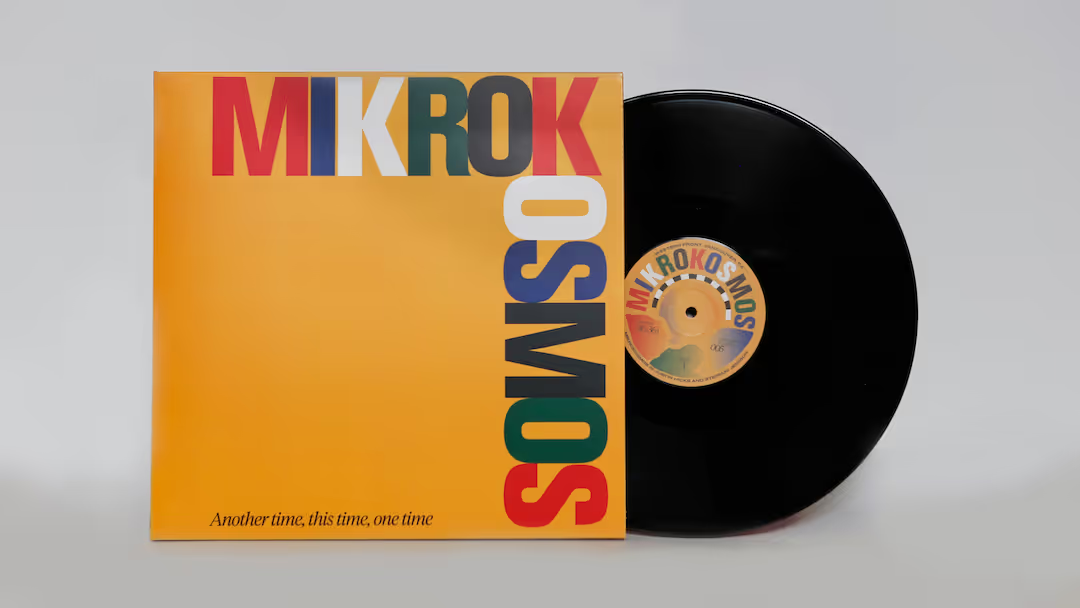
Formed in 2016 as the collaborative platform of composer Justin Hicks and artist Steffani Jemison, Mikrokosmos mines the history of Black music. This ongoing project has manifested in many forms: workshop, study session, concert, listening session, book, prompt, score.
'Mikrokosmos, like all black music, is a form of speculation. It is ‘study without end’ (Moten and Harney, 2015); blackness is its subject. Anti-languages and alternative literacies have persisted in the African American community since slavery, and Mikrokosmos embraces the spirit of these radical approaches to language and learning. With our collaborators, we derive new proposals for understanding and teaching pitch and rhythm from the black vernacular songbook. Mikrokosmos is influenced by diverse music pedagogical programs and contexts, including the Orff Schulwerk, the Kodaly method, Béla Bartok's Mikrokosmos piano learning exercises, and the musical learning methodologies of the black American church, among others. The current research uses the melodic and rhythmic conventions of songwriter Gil Scott-Heron as tools for articulating revolutionary melancholy.' said Steffani Jemison and Justin Hicks.
Other artists in the exhibition:
Yael Bartana, Jean-Michel Basquiat, Sophie Calle, Contemporary And, Sadie Barnette, CHTO DELAT?, Melvin Edwards, Ângela Ferreira, Bernhard Franke, Coco Fusco, Ellen Gallagher, Claudia Martínez Garay, Lawrence Abu Hamdan, Arthur Jafa, Steffani Jemison & Justin Hicks (Mikrokosmos), Iris Kensmil, Hassan Khan, Kapwani Kiwanga, Raja Lubinetzki & Petra Schramm, Julie Mehretu, Heinz-Detlef Moosdorf, Senga Nengudi, Ahmet Ö?üt, Slavs and Tatars, Julia Phillips, Alex Martinis Roe, Elske Rosenfeld, Anri Sala, Willi Sitte, Cauleen Smith, Nancy Spero, Gabriele Stötzer, Strawalde (Jürgen Böttcher), Nasan Tur, Lewis Watts, Carrie Mae Weems, Christoph Wetzel, Charles White, Heinz Wodzicka.

