

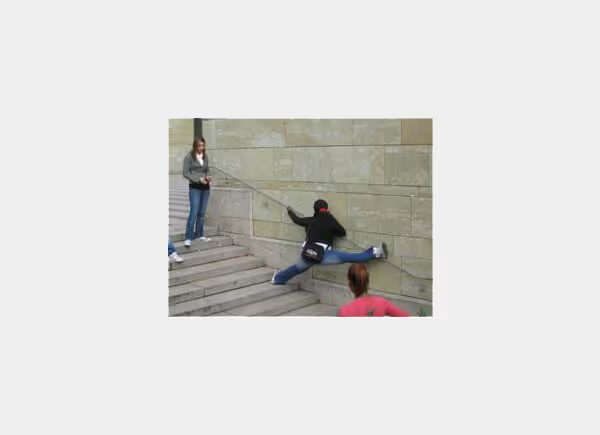
The Outset Youth Projects at the Pinakothek der Moderne Munich have been running since 2006. Working alongside well-known international contemporary artists and contemporary art collections the projects give young people the opportunity to engage in creative practices within the context of international contemporary art. The workshops are directed towards young people who, either through disability or social deprivation, have had little opportunity to visit public museums or galleries.
British artist Lottie Child’s practice is participatory, live, and situation-based, using collaboration and spontaneous interaction. She concerns herself with relationships, to ourselves, to others and the spaces around us. Her work is rooted in live participatory performances, maps, community building and education processes. When thinking about how behaviour shapes public spaces, the concept of ‘Street Training’ was born. This project - running from 2006-2019 in various cities - explored how people engage with their urban environment and highlighted the fact that these spaces have been limited in how we use them and all signs of creativity have disappeared. In tackling this, ‘Street Training’ is all about movement and using space in a freeing and fun way. Child runs children’s workshops as, according to her, they tend to be more creative when reclaiming space. She sees her practice as a way of rethinking education and a process from which she can learn, too.
During this collaboration with the Pinakothek der Moderne Munich, Lottie Child invited her workshop participants to discover the city of Munich through ‘Street Training’. Incorporating the idea that physical movement is a precursor to mental activity, she asked the youths to transgress and redefine visible and invisible barriers by using their bodies in a creative and playful way. Fences and walls were either climbed to instigate a feeling of barriers being overcome or broken down. Using these experiences, an alternative street map of Munich was made, which mirrored the unusual use of the ‘Kunstareal’ area and had the effect of encouraging others to follow these activities.

