

ON VIEW 26th October – 27th November 2022.
VENUE: Museum of Folk Art & Tradition Angeliki Hadjimichali
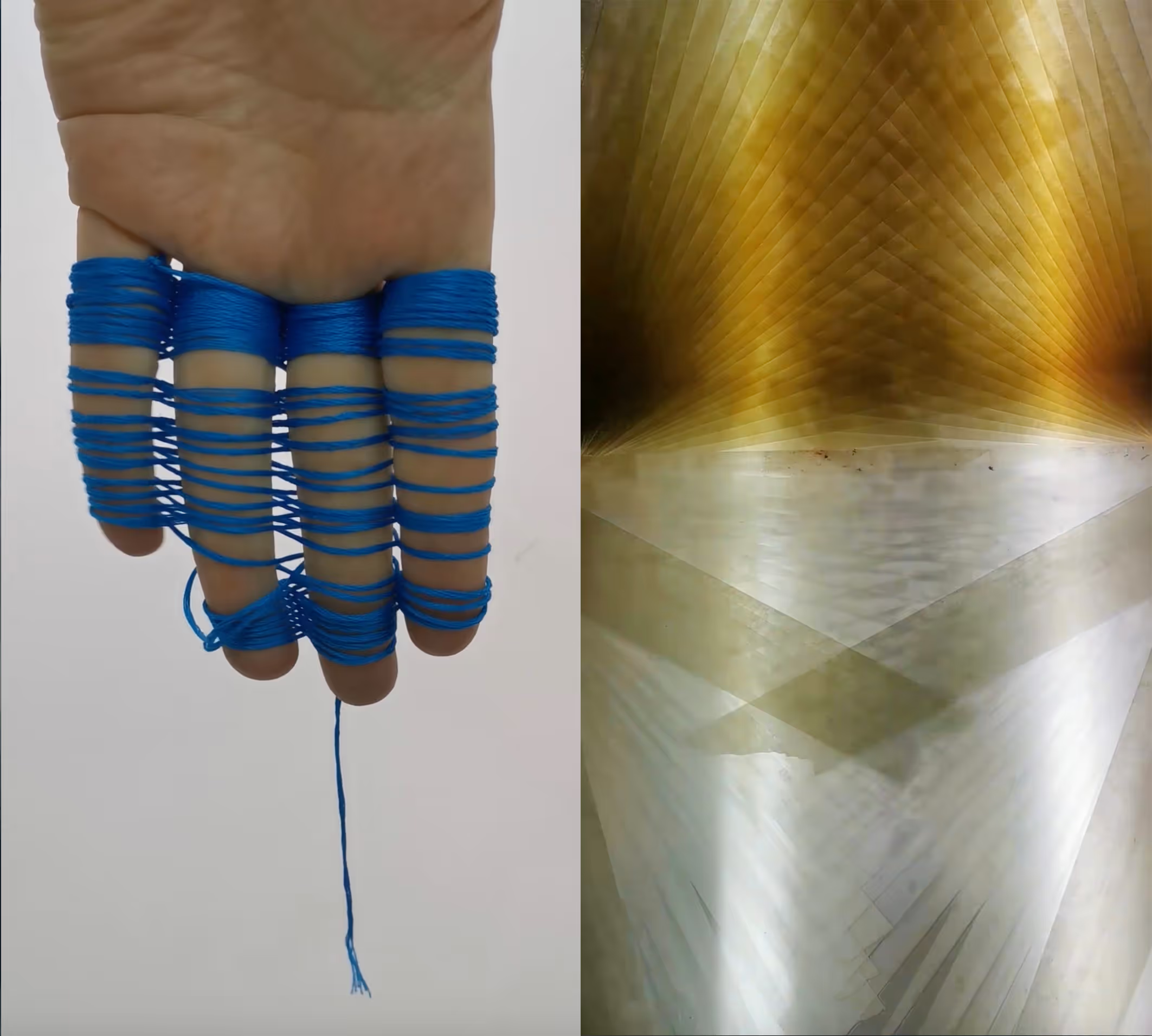
'STORM (I Don't Have a Pen)', Myrto Xanthopoulou’s exhibition was designed specifically for the City of Athens Museum of Folk Art and Tradition Aggeliki Chatzimichali and presented from October 26 until November 27, 2022. Focusing on the process of making things with one’s hands, on matter and words, the exhibition is held at the former residence of the high priestess of Greek folklore, who devoted her life to promoting and preserving the value and variety of Greece’s artisanal heritage. In her works, Xanthopoulou uses everyday materials in a handmade process involving the use of language to create installations and constructions that highlight the way in which all these elements convey meaning, which both the artist and the public seek.
In collaboration with PH LS PH Philosophy and Photography Lab
With the support of the Outset Contemporary Art Fund Greece.
Extract from catalogue text by the curator Christoforos Marinos:
"For STORM (I don’t have a pen), her fifth solo exhibition, Xanthopoulou temporarily camps at Aggeliki Chatzimichali’s residence. Designed specifically for this venue, the exhibition features a series of sculptures and a video, on view in three adjacent rooms. A composition with blue pen on tracing paper commands the main room, hanging above the elaborate fireplace. Written in large letters on the paper surface, the phrase ‘The tap is dripping’ conveys a warning message that needs no interpretation. For Xanthopoulou, in fact, language is a code; by every phrase she writes, she means something else. Similarly, STORM has a multiplicity of meaning, according to the artist: ‘There is a certain verticality about the title. A storm can involve crying, an outbreak, a sequence of events, of emotions, of words – a natural phenomenon when, as long as it is unfolding, everything else seems to come to a halt. There is something dramatic about this word, but it’s also a bit larger than life, almost funny (bringing to mind the Andipas song of the same title). It conveys the drama while undermining it at the same time.’ The artist notes that she sees all her works as text: ‘I generally have a textual perception of things. There are always words and phrases in my head – narratives around which I construct my works and understand them. And I still read them as a text even when it is absent.’
Xanthopoulou’s untold hardship is the physical suffering she endures when making her ‘luggage constructions,’ where ‘sloppiness goes hand in hand with an arduous, exhausting manual process.’ This ‘exhaustive appropriation’ is characteristic of all the sculptures in this exhibition, which feature phrases such as ‘I’m tired,’ ‘I don’t care’ and ‘We are all a mess.’ Packaging paper dipped in glue and oil paint, plaster bases that speak to the binary opposition light/heavy, a miniature kiosk with a plastic canopy, word and phrase fragments, mock-ups in wood and paper, bamboo buttresses, paper with imprints of the artist’s hands, words written in nail polish, papercuts with spray paint, a construction in cigarette paper that looks as if a spacecraft has just landed in the dining room – together, all these pieces make up an exhibition in which materiality and language, physicality and care take the spotlight.
In early incarnations, many of the objects embedded in these sculptures appear in the videos made on a smartphone and uploaded as Instagram Stories. This is ‘a collection of small gestures, shots and words, all woven together like handiwork.’ She notes that these videos compose an ‘experiential dictionary,’ a ‘record of gestures’ that illuminate various aspects of her practice – physical, performative, sonic. ‘They open a window to the inner world of the studio, the home, the lulls when nothing is happening, and anything can happen.’ In the ten-minute video 100KarateBlows (2021-22), on view in this exhibition as part of a construction, language operates similarly to a medium for sculpture. The artist’s voice constantly reiterates phrases (‘It’s all frequencies’/ ‘Same story every day’) which illustrate the performative nature of her practice. The videos are intentionally crude, made without any post-production: ‘It’s almost like a type of arte povera. I work with what I have, what I can find at home, in the studio, on the balcony, on the sidewalk, in my local paper shop,’ says the artist."

