

Artists Tatiana Trouvé was a guest of Outset Bialik Residency during June 2018, for the installation of her solo exhibition "The Great Atlas of Disorientation" at Petach Tikva Museum of Art, curated by Hadas Maor.
The first notions that come to mind when thinking of Tatiana Trouvé’s oeuvre are extreme delicacy, restrained violence, and an overwhelming sense of ephemerality, which cannot be reconciled. In her work, Trouvé investigates the relations between time and space through the creation of enigmatic environments that rely on logical, architectural, and material disruptions. These environments are given expression both in large-scale drawings and in large-scale, mostly site-specific installations. The constant vacillation between the drawings and the sculptural and architectural installations creates a sense of flow from one medium to another, of the reflection of one action in another, and of the commingling of ostensibly disparate worlds. The various spaces created in these works contain the concept of time in various ways – spatially, semiotically, and poetically, as if attempting to map what has vanished and no longer exists – perhaps even oblivion itself.
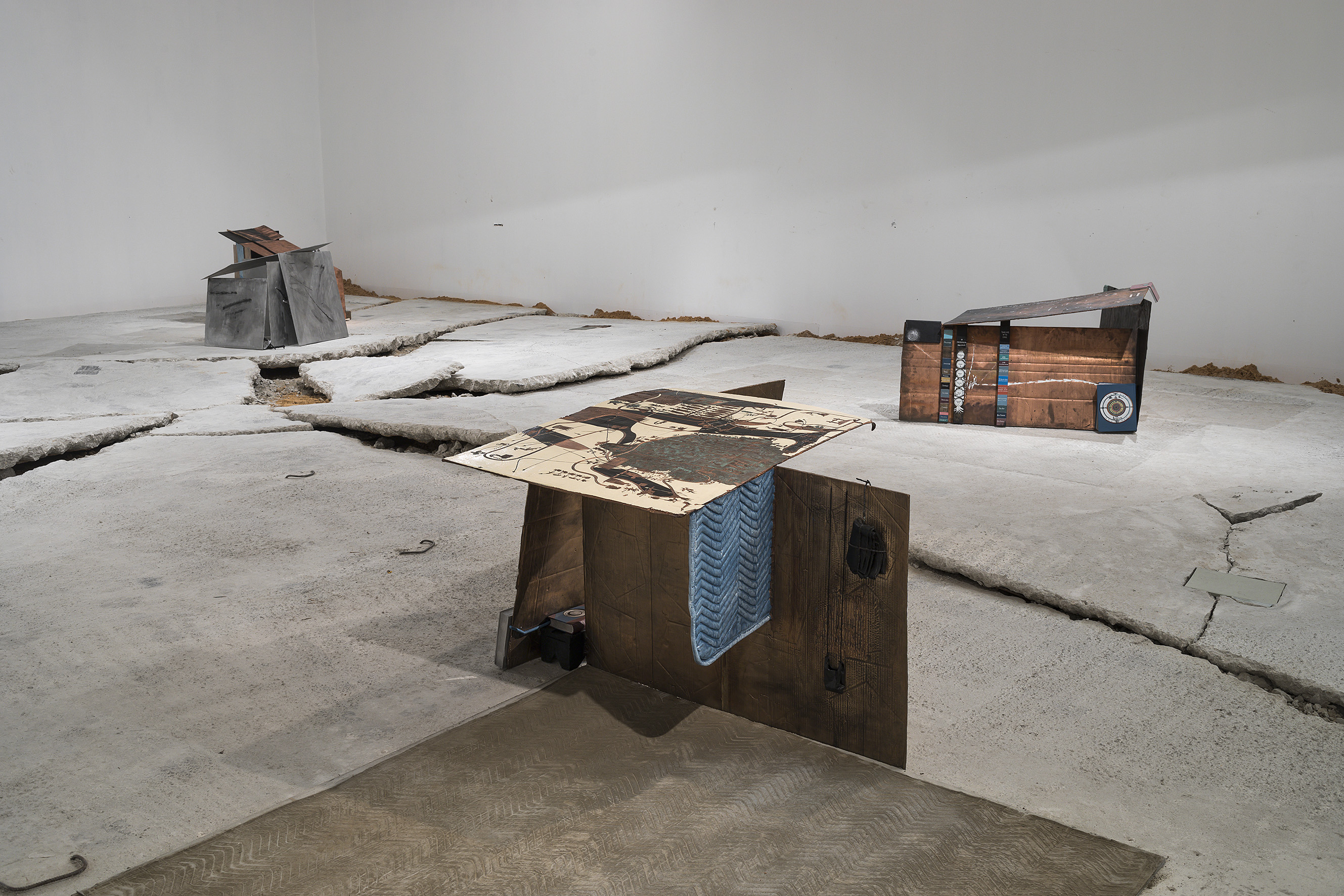
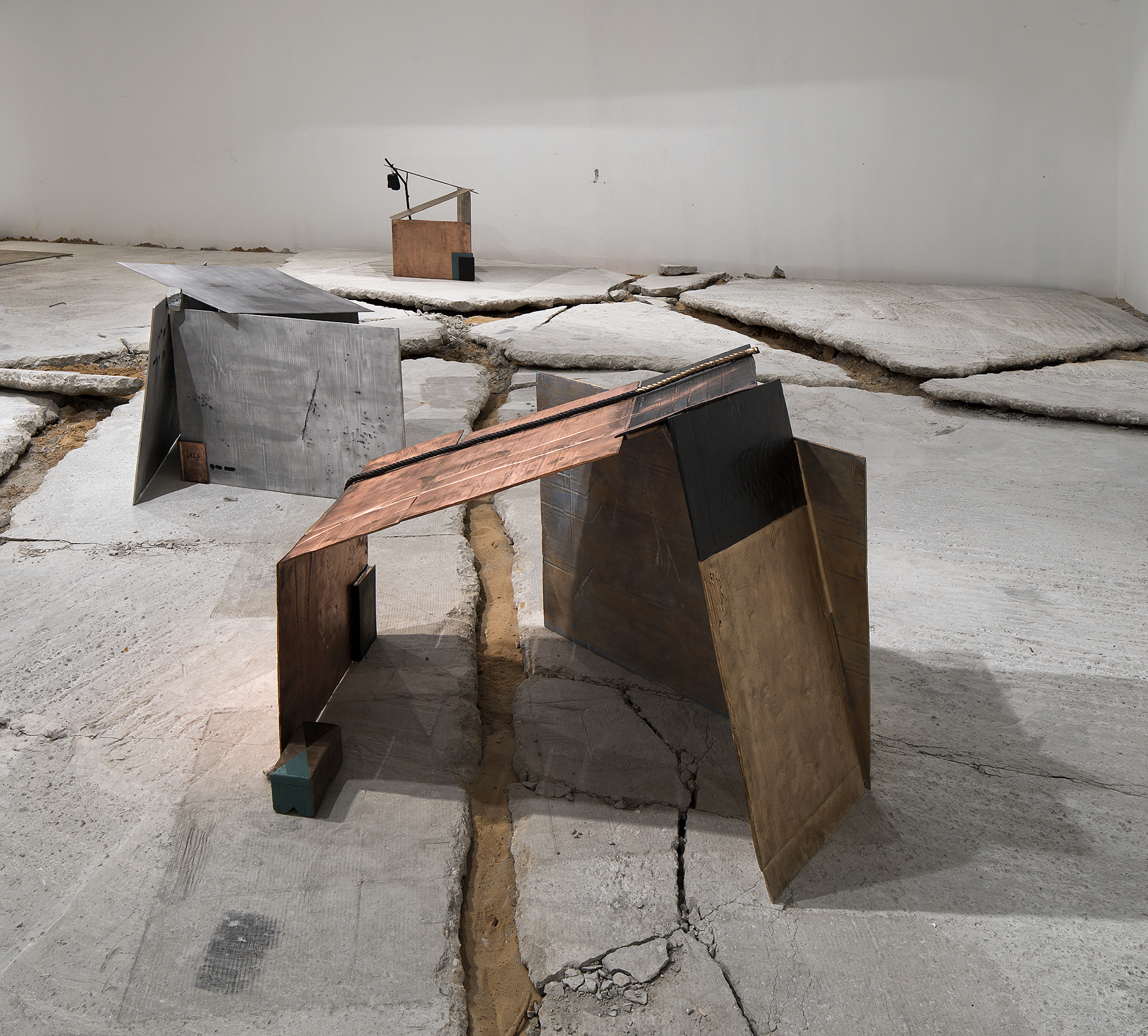
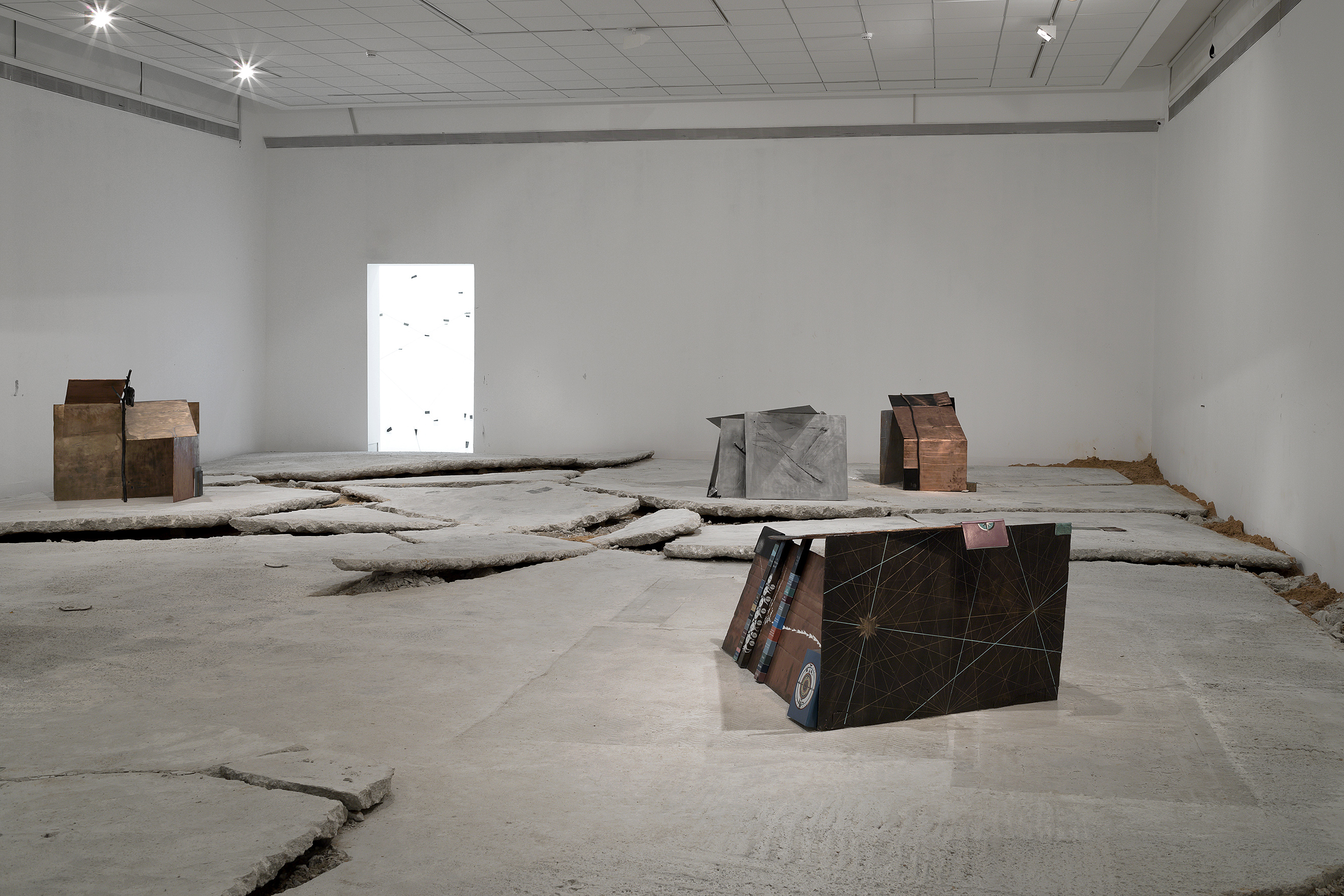
This exhibition featured two large-scale, site-specific installations by Trouvé. In the first space, the viewer came upon a cracked, broken surface on which several sculptural objects are scattered: temporary shelters of sorts cast from used sheets of cardboard in bronze, aluminium, and copper. Affixed to the sides of these structures were old diaries, various objects, and additional material elements. On some of these surfaces, Trouvé imprinted maps and signs that refer to a wide range of time periods and cultures.
The works oscillated between history and fiction, a general stance and a particular stance, while existing as both conceptual representations and narrative carriers. From a structural perspective, the sculptural objects were basic, minimalist constructions, which offered only partial shelter. They were not entirely closed off from the outside, and thus did not produce an actual interior, but rather an interrelated exterior and interior that invade one another. In this sense, they offered a series of new perspectives on the world – partial, changing perspectives that swirl and emerge out of one another, offering a fundamental contrast to the omnipresent gaze offered by the structure of the panopticon, for instance.
The space carried the tension between softness and rigidity, permanence and transience, catastrophe and utopia – as well as between past, present, and future. Above all, it raised questions concerning perspective, time, and memory. This tension involved an exploration of the concept of home, while raising acute questions concerning displacement, immigration, and the quest for a larger cultural context and meaning.
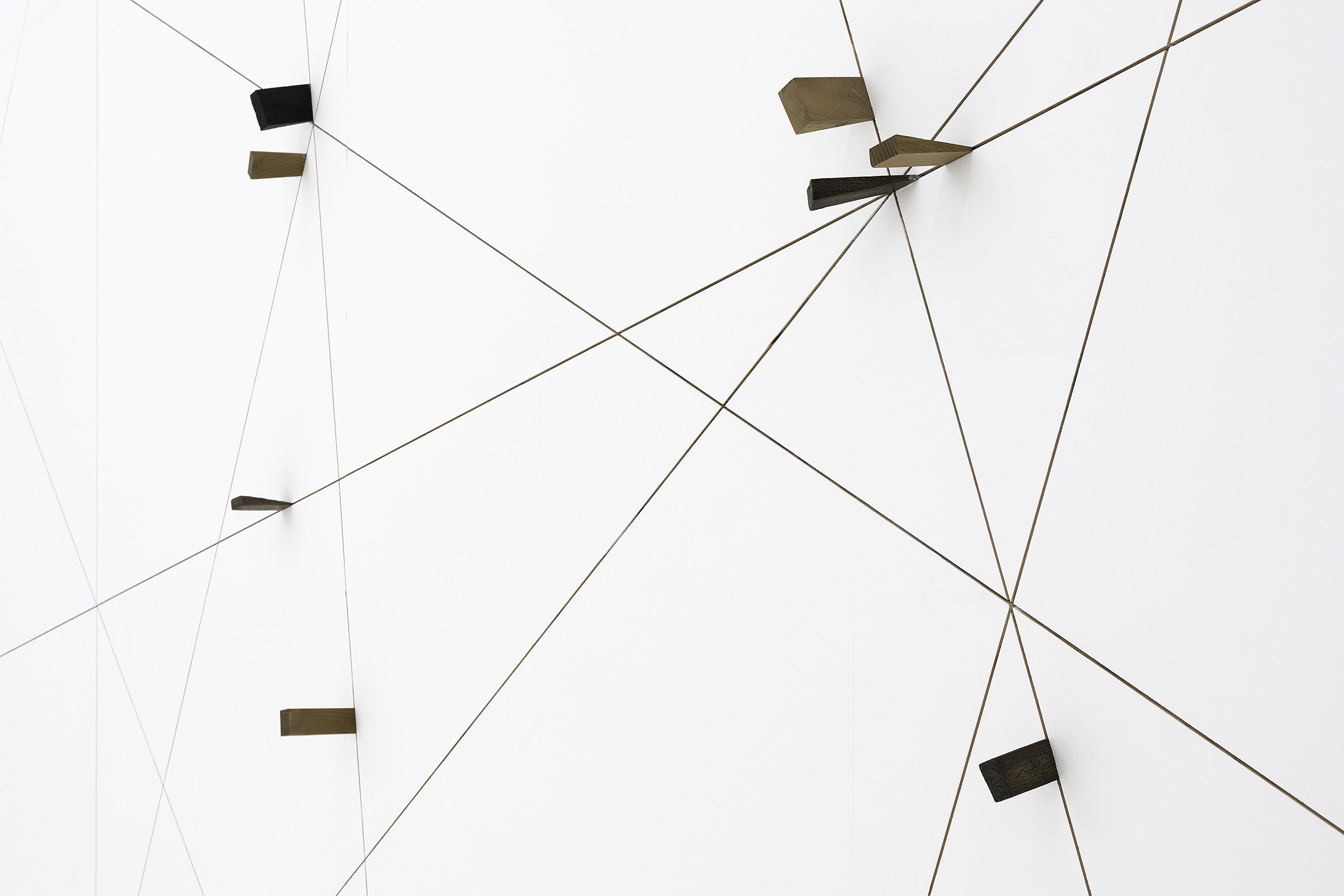
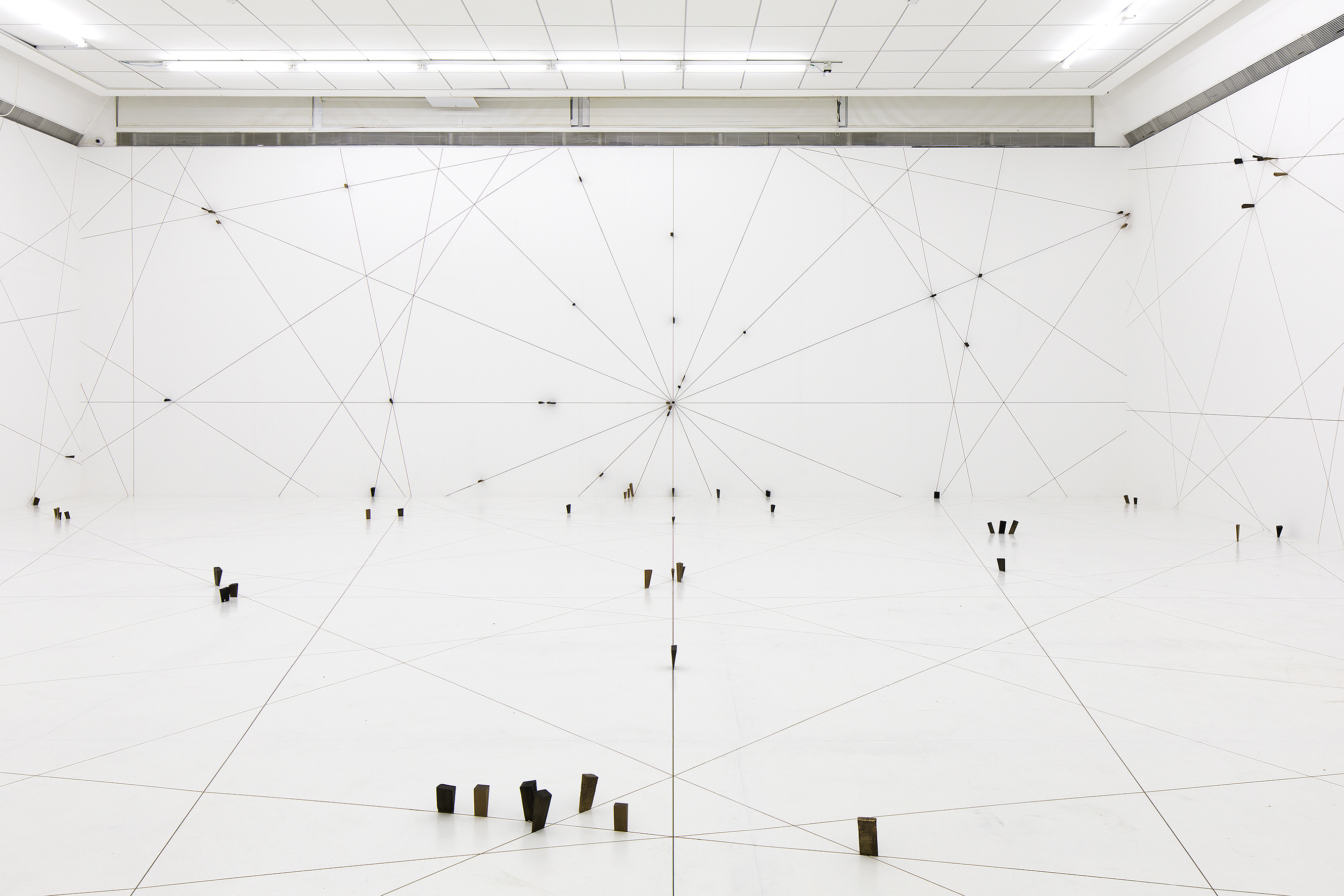
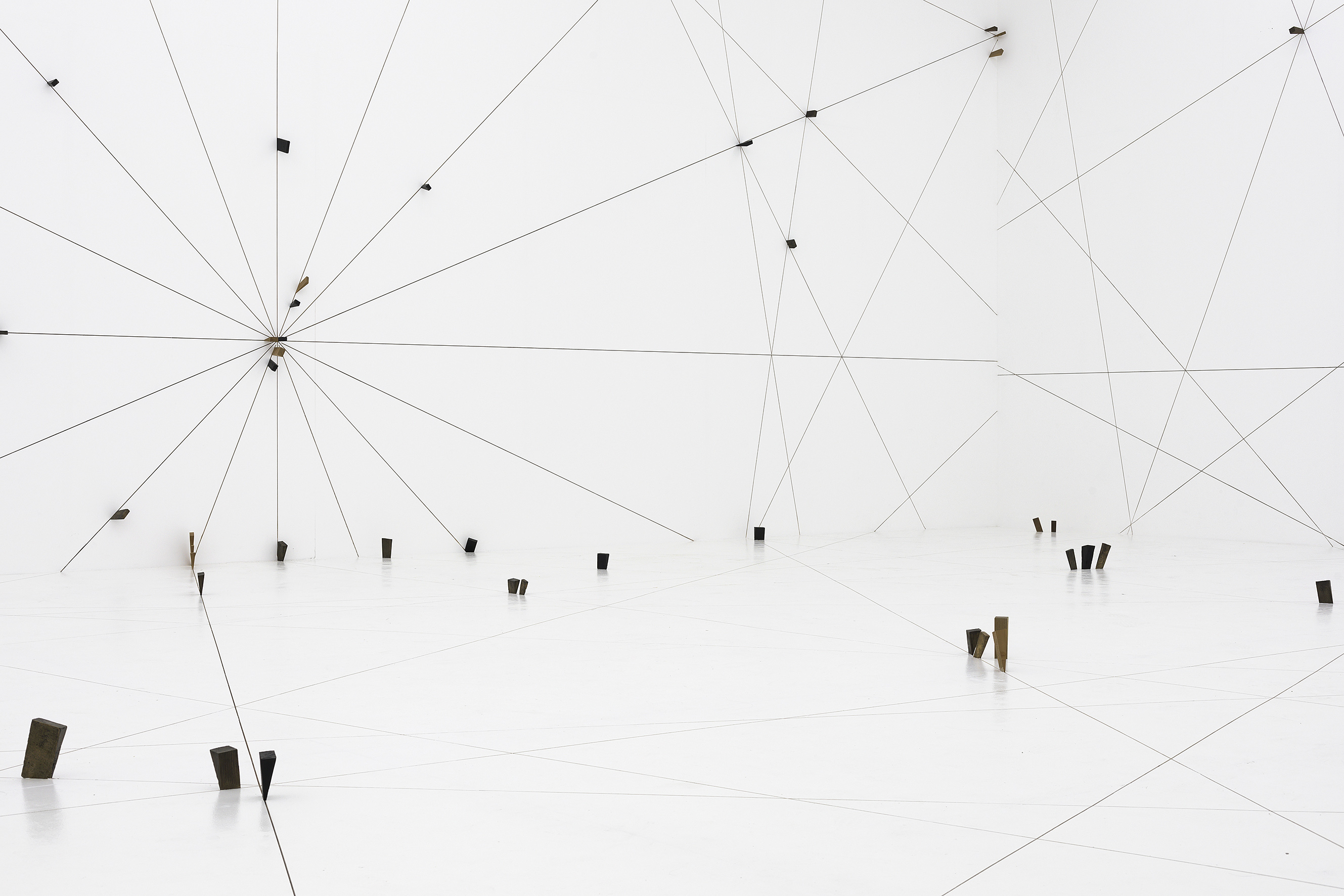
The transition to the interior space, which featured the work Prepared Space (2018), amplified the sense of immersion within the work. The action of drawing that was already identified in the temporary seems to have expanded in space, covering the entire floor and walls and totally enveloping the viewer situated within it. The entirely white space was marked by trajectories, long slits into which spacers. The various trajectories intersected and came together to form an abstract navigation map with several vanishing points, which was in fact a mathematical drawing that always includes a set number of trajectories. The spacers inserted into the work usually served to fix supporting beams prior to the casting of concrete, and were assimilated into the cast as it is made. In this work, they were stripped of their function and remained exposed to the gaze as they punctuate the space.
ON VIEW: 7th June - 29th September 2018.

